Umrah is a pilgrimage to Makkah that Muslims can perform at any time of the year, unlike Hajj, which takes place during specific days of Dhul-Hijjah. It is a meaningful act of worship that includes entering Ihram, performing Tawaf around the Kaaba, completing Sai between Safa and Marwah, and ending the Umrah with Halq or Taqsir.
If you are performing Umrah for the first time, knowing the correct order of these steps can help you feel more prepared and focused. From getting ready before Ihram and reaching the Miqat to completing Tawaf, Sai, and the final cutting or shaving of the hair, each stage has its own requirements and recommended actions.
This Umrah guide explains how to perform Umrah step by step in a simple and practical order. It covers what to do at each stage, what is required, what is recommended, and common mistakes to avoid, so you can understand the complete Umrah process before beginning your journey.
The Four Main Steps of Umrah
The four main stages of Umrah are simple to follow, but each one includes important details that pilgrims should understand. In particular, it is important to know when and where to enter Ihram, how to perform and count Tawaf and Sai correctly, what to recite, and which restrictions apply while in Ihram.
The basic sequence of Umrah is:
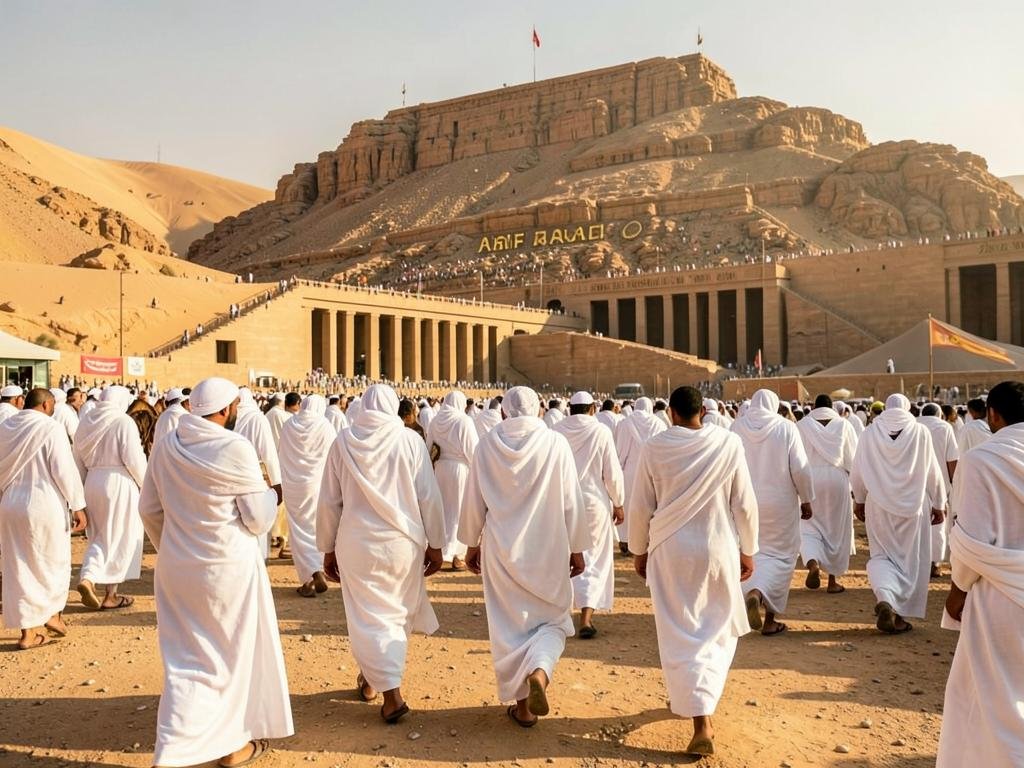
- Prepare for Ihram and enter it at the Miqat: Bathe and prepare yourself as appropriate, put on Ihram clothing where applicable, make the intention for Umrah, and begin reciting the Talbiyah.
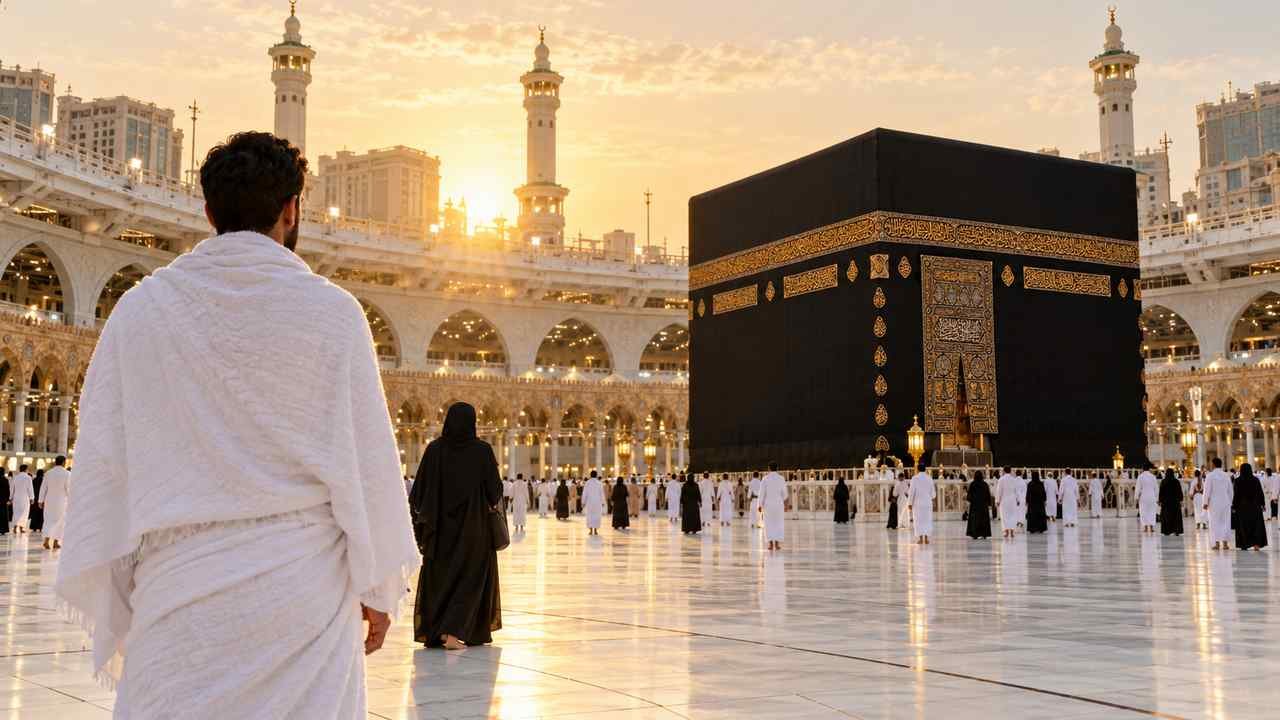
- Perform Tawaf: Circumambulate the Kaaba seven times, beginning from the area of the Black Stone.
- Perform Sai: Walk seven times between Safa and Marwah, beginning at Safa and finishing at Marwah.
- Complete the Umrah: Men shave or shorten their hair, while women shorten their hair according to the applicable guidance. This marks the completion of the ritual and the end of the state of Ihram.
Step 1: Enter Ihram and Begin Your Umrah
Ihram is more than the clothing worn by a pilgrim. It refers to the sacred state a person enters for the performance of Umrah, together with the rules and restrictions that apply during that state.
Before crossing the relevant Miqat, a pilgrim intending to perform Umrah should be ready to enter Ihram and make the intention for Umrah.
What Is Ihram?
For men, the word Ihram is often associated with the two pieces of cloth worn during Umrah. However, the clothing itself is not the entire meaning of Ihram. Ihram is the state of consecration entered for the pilgrimage, during which particular rules apply.
Women do not wear the same two-piece Ihram garments as men. A woman may wear suitable modest clothing while observing the relevant restrictions of Ihram.
Understanding this distinction is important because changing into Ihram clothing and entering the state of Ihram are related but not identical concepts.
Make the Intention for Umrah
Once you are ready to enter Ihram at the appropriate point, make your intention to perform Umrah. The intention is fundamentally an act of the heart. You do not need to construct a complicated statement or repeatedly verbalize the intention simply because you are worried about saying it perfectly.
After making the intention, the pilgrim begins the Talbiyah.
Recite the Talbiyah
The Talbiyah is the well-known supplication recited by pilgrims after entering Ihram for Hajj or Umrah.
Talbiyah:
لَبَّيْكَ اللَّهُمَّ لَبَّيْكَ، لَبَّيْكَ لَا شَرِيكَ لَكَ لَبَّيْكَ، إِنَّ الْحَمْدَ وَالنِّعْمَةَ لَكَ وَالْمُلْكَ، لَا شَرِيكَ لَكَ
Transliteration:
Labbayka Allahumma labbayk. Labbayka la sharika laka labbayk. Innal-hamda wan-ni‘mata laka wal-mulk. La sharika lak.
Meaning:
Here I am, O Allah, here I am. Here I am, You have no partner, here I am. Indeed, all praise, blessings, and sovereignty belong to You. You have no partner.
The Talbiyah should be recited as part of the pilgrim’s journey toward the Sacred Mosque and continued according to the established practice until the appropriate point in the Umrah. (Sahih Muslim, Hadith 1184b)
Important Ihram Restrictions
Once you enter Ihram, certain actions become prohibited. These include restrictions concerning matters such as cutting hair or nails, applying perfume, hunting land game, and marital relations. Some rules also differ between men and women, so it is important to understand the restrictions that apply to you.
Because the consequences and detailed rulings can vary according to the circumstances and school of Islamic jurisprudence, a pilgrim should not rely on a simplified internet checklist when dealing with a specific situation that may affect the validity of an act or require compensation.
For a straightforward Umrah, the most useful approach is to understand the main Ihram restrictions before entering Ihram and to ask a qualified scholar about any personal circumstances that are unclear. Once you have entered Ihram correctly and reached Makkah, the next major stage is Tawaf around the Kaaba.
Step 2: Perform Tawaf Around the Kaaba
After entering Makkah and reaching Masjid al-Haram, the next major stage of Umrah is Tawaf. Tawaf means circumambulating the Kaaba seven times, keeping the Kaaba to your left as you move around it.
Before beginning, make sure you know where you are starting and allow the flow of pilgrims to guide your movement. The Saudi Ministry of Hajj and Umrah advises pilgrims to begin Tawaf in line with the Black Stone, move gently with the crowd, and avoid walking against the direction of Tawaf or creating congestion.
Where Tawaf Begins
Tawaf begins at the Black Stone. If you can reach it without pushing, hurting, or seriously disturbing other pilgrims, you may touch it or kiss it according to the established practice.
However, you do not need to force your way through a crowd to reach the Black Stone. The Prophet ﷺ was also reported to have pointed toward the Corner when performing Tawaf, demonstrating that physical contact is not a requirement when it cannot be safely achieved.
The objective is worship, not reaching the Black Stone at any cost.
How to Perform the Seven Circuits
Once you begin, keep the Kaaba on your left and proceed around it until you return to the starting point. That completes one circuit.
Repeat this until you have completed seven circuits.
A simple way to avoid losing count is to keep your own count rather than relying on another member of your group. If you become uncertain about your count, follow the appropriate guidance from a qualified scholar, particularly if the uncertainty could affect the completion of your Tawaf.
What to Do at the Black Stone and Yemeni Corner
The Black Stone is the starting and ending reference point for each circuit. The Yemeni Corner is another corner of the Kaaba encountered before reaching the Black Stone again. There is an established practice of touching the Yemeni Corner when this can be done without causing harm or difficulty. A report in Sahih Muslim describes Ibn Umar observing the Prophet ﷺ touching the Yemeni Corner and the Black Stone. (Sahih Muslim, Hadith 1267a)
If you cannot comfortably reach the Yemeni Corner, there is no need to push through people or create a disturbance. The other corners of the Kaaba should not be treated as though they have the same ritual practice as the Black Stone.
What Should You Recite During Tawaf?
There is an important distinction between established supplications and personal dua. You may remember Allah, recite Quran, make dua, and ask Allah for whatever is good during Tawaf. You do not need to follow a complicated script containing a different mandatory dua for every circuit.
One established supplication associated with the section between the Yemeni Corner and the Black Stone is:
Arabic:
رَبَّنَا آتِنَا فِي الدُّنْيَا حَسَنَةً وَفِي الْآخِرَةِ حَسَنَةً وَقِنَا عَذَابَ النَّارِ

Transliteration:
Rabbana atina fid-dunya hasanatan wa fil-akhirati hasanatan wa qina ‘adhaban-nar.
English Meaning:
Our Lord, give us good in this world and good in the Hereafter, and protect us from the punishment of the Fire.
(Surah Al-Baqarah, 2:201)
Should Men Walk Quickly During Tawaf?
There are established Sunnah practices for men concerning the first three circuits of Tawaf, including ramal, a form of brisk walking, in the circumstances where it is applicable. The practice is reported in Sahih al-Bukhari 1602 and 1603.
There is also the practice known as idtiba, in which a male pilgrim exposes the right shoulder during Tawaf. The details of when and how idtiba is practiced are subject to established fiqh guidance, so pilgrims should follow the ruling applicable to their circumstances.
These practices should not be treated as reasons to push, collide with other pilgrims, or move dangerously through a crowded area. The purpose of Sunnah is not to create harm or disorder. Saudi Ministry guidance also emphasizes moving gently with the crowds and avoiding congestion.
After Completing Tawaf
After the seventh circuit, move away from the Tawaf flow rather than stopping in a place where other pilgrims are still circulating.Two Rak‘ahs are traditionally prayed after Tawaf.
If praying close to Maqam Ibrahim would obstruct other worshippers, do not create a crowd there. The priority is to worship without preventing others from moving. After Tawaf, the pilgrim can proceed toward the area of Safa and Marwah for Sai.
Step 3: Perform Sai Between Safa and Marwah
Sai is the next major stage of Umrah. It consists of seven trips between Safa and Marwah, beginning at Safa and ending at Marwah.
The two hills are located within Masjid al-Haram, and Sai commemorates the worshipful journey associated with Hajar, the mother of Ismail. The Quran identifies Safa and Marwah as among the symbols of Allah:
Arabic:
إِنَّ الصَّفَا وَالْمَرْوَةَ مِن شَعَائِرِ اللَّهِ ۖ فَمَنْ حَجَّ الْبَيْتَ أَوِ اعْتَمَرَ فَلَا جُنَاحَ عَلَيْهِ أَن يَطَّوَّفَ بِهِمَا ۚ وَمَن تَطَوَّعَ خَيْرًا فَإِنَّ اللَّهَ شَاكِرٌ عَلِيمٌ
Transliteration:
Innaṣ-ṣafā wal-marwata min sha‘ā’irillāh. Faman ḥajja al-bayta awi‘tamara falā junāḥa ‘alayhi an yaṭṭawwafa bihimā. Wa man taṭawwa‘a khayran fa innallāha shākirun ‘alīm.
English Translation:
Indeed, Safa and Marwah are among the symbols of Allah. So whoever performs Hajj or Umrah at the Sacred House, there is no blame upon him for walking between them. And whoever does good voluntarily, then surely Allah is Appreciative, All-Knowing. (Surah Al-Baqarah, 2:158)
The wording of the verse should not be misunderstood as suggesting that Sai is merely optional. The historical context of the verse explains the concern addressed to the early Muslims, while the established practice of the Prophet ﷺ demonstrates the performance of Sai as part of Hajj and Umrah. Aisha رضي الله عنها explained this context when discussing the verse with Urwah.
Starting Sai at Safa
Sai begins at Safa. When approaching Safa, remember that you are beginning a distinct act of worship. The journey from Safa to Marwah counts as one trip, and the journey from Marwah back to Safa counts as another.
This means the count works as follows:
- Safa → Marwah = 1
- Marwah → Safa = 2
- Safa → Marwah = 3
- Marwah → Safa = 4
- Safa → Marwah = 5
- Marwah → Safa = 6
- Safa → Marwah = 7
You therefore finish at Marwah. Keeping this sequence clear is one of the easiest ways to prevent confusion during Sai.
What to Recite During Sai
As with Tawaf, you do not need to recite a specific memorized formula for every step of Sai. You may remember Allah, make personal dua, and recite the Quran throughout Sai.
When you reach Safa, you may recite:
إِنَّ الصَّفَا وَالْمَرْوَةَ مِنْ شَعَائِرِ اللَّهِ

Innaṣ-Ṣafā wal-Marwata min sha‘ā’irillāh.
Meaning:
Indeed, Safa and Marwah are among the symbols of Allah.
You may then face the Qiblah and recite:
لَا إِلَٰهَ إِلَّا اللَّهُ وَحْدَهُ لَا شَرِيكَ لَهُ، لَهُ الْمُلْكُ وَلَهُ الْحَمْدُ وَهُوَ عَلَىٰ كُلِّ شَيْءٍ قَدِيرٌ. لَا إِلَٰهَ إِلَّا اللَّهُ وَحْدَهُ، أَنْجَزَ وَعْدَهُ، وَنَصَرَ عَبْدَهُ، وَهَزَمَ الْأَحْزَابَ وَحْدَهُ.
Lā ilāha illallāhu waḥdahu lā sharīka lah, lahul-mulku wa lahul-ḥamdu wa huwa ‘alā kulli shay’in qadīr. Lā ilāha illallāhu waḥdahu, anjaza wa‘dahu, wa naṣara ‘abdahu, wa hazamal-aḥzāba waḥdah.
Meaning:
There is no deity worthy of worship except Allah alone, without a partner. His is the dominion and His is the praise, and He has power over all things. There is no deity worthy of worship except Allah alone. He fulfilled His promise, helped His servant, and alone defeated the confederates.
The Prophet ﷺ then made dua, and this remembrance and supplication were repeated. He also did at Marwah what he had done at Safa. This is reported in Sahih Muslim 1218a.
There is no fixed dua that must be recited for each of the seven trips. While walking between Safa and Marwah, you may make personal dua, remember Allah, and recite the Quran. The specific remembrance described above is associated with reaching Safa and Marwah rather than with each individual trip.
What Men and Women Do During Sai
There is an established Sunnah for men to walk briskly between the designated markers during Sai, where applicable. Women do not have the same requirement to jog.
As with the corresponding practices during Tawaf, the action should never become an excuse for pushing, running into other pilgrims, or creating a safety risk. Follow the conditions of the area and the instructions of the authorities.
After the seventh trip ends at Marwah, the pilgrim moves to the final stage of Umrah: shortening or shaving the hair.
Step 4: Halq or Taqsir: Completing Umrah
The final stage of Umrah is Halq or Taqsir. For men, Halq means shaving the head, while Taqsir means shortening the hair. For women, the hair is shortened rather than shaved.
Once this stage is completed according to the applicable ruling, the Umrah is complete and the restrictions of Ihram come to an end.
The distinction between Halq and Taqsir should not be reduced to simply choosing whichever option seems easier. There are established rulings and differences concerning the preferable practice and how much hair should be shortened, so a pilgrim with a specific fiqh question should consult a qualified scholar.
Umrah Duas and What to Recite During the Rituals
A common source of confusion is the large number of Umrah dua lists available online. Some present a separate fixed dua for every circuit of Tawaf or every trip of Sai as though the pilgrim must recite those exact words. That approach can make a simple act of worship unnecessarily complicated.
There are, however, established supplications and remembrances associated with particular parts of Umrah. The main recitations include:
- When entering Ihram: Make the intention for Umrah and begin reciting the Talbiyah.
- During Tawaf: Remember Allah and make personal dua. There is no fixed dua that must be recited for each of the seven circuits. The Rabbana atina supplication from the Quran is commonly recited between the Yemeni Corner and the Black Stone.
- At Safa and Marwah: Recite the established remembrance and make dua when reaching Safa and Marwah. There is no separate mandatory dua for each trip to Sai.
- During Sai: You may make personal dua, remember Allah, and recite the Quran. There is no required fixed script for each of the seven trips.
- Throughout Umrah: You may ask Allah for what is beneficial in this life and the Hereafter using words you understand.
The Talbiyah has an established wording, and there are established supplications and remembrances connected with particular parts of the rites. But this does not mean that every circuit has a mandatory script.
If you do not know an Arabic supplication, you can still turn to Allah sincerely and ask for what you need. Avoid assuming that a dua becomes Sunnah simply because it appears in a popular Umrah booklet or on a website.
Important Rules and Common Mistakes During Umrah
Knowing the sequence of Umrah is only part of preparation. First-time pilgrims can also become confused by small practical issues during the rituals.
Mistake 1: Treating Ihram as Only Clothing
Ihram is not simply the white clothing worn by men. It is the state of worship in which specific restrictions apply. Understanding this before reaching the Miqat helps prevent mistakes after entering Ihram.
Mistake 2: Crossing the Miqat Without Entering Ihram
Someone intending to perform Umrah should know the relevant Miqat for their route before travelling. This is particularly important for air travel, as pilgrims should enter Ihram at the Miqat applicable to their route rather than deliberately passing it without Ihram.
Because routes and individual circumstances differ, do not assume that the same Miqat applies to every pilgrim.
Mistake 3: Pushing to Reach the Black Stone
Touching or kissing the Black Stone is not worth injuring another Muslim or creating dangerous congestion. If you cannot reach it safely, indicate toward it when appropriate and continue your Tawaf.
Mistake 4: Losing Count of Tawaf
Crowds, fatigue, and distractions can make counting difficult. Before beginning, use a simple method to keep track. Remember that one complete circuit starts at the Black Stone and ends when you return to it.
Mistake 5: Assuming Every Circuit Has a Required Dua
There is no need to panic if you do not know a special dua for each circuit. Make dhikr, recite Quran, and make personal supplication while following the established practices you know to be authentic.
Mistake 6: Treating Sunnah Actions as Reasons to Cause Harm
Practices such as brisk walking during the applicable portion of Tawaf for men or jogging between the markers during Sai should be performed appropriately and without harming others.
In crowded conditions, follow current instructions from the authorities and prioritize safety and orderly movement.
Umrah for First-Time Pilgrims
For someone performing Umrah for the first time, the entire process can be remembered as one simple sequence:
Miqat → Ihram → Intention and Talbiyah → Tawaf → Two Rakahs → Sai → Halq or Taqsir → Completion of Umrah
Do not let the number of details make the ritual seem impossible. Learn the sequence first, then study the details of each stage.
If you are uncertain about a specific religious matter, particularly one involving a mistake during Ihram, Tawaf, or Sai, the appropriate response is to ask a qualified scholar rather than assuming that an online checklist settles the matter.
For current administrative requirements, permits, access arrangements, and other Saudi regulations, consult official Saudi sources because these matters can change independently of the timeless ritual sequence.
Final Thoughts on Performing Umrah
The best way to approach Umrah is to understand the sequence before you arrive and then take each stage calmly. This guide from Hajj Umrah Guider walks you through that sequence: enter Ihram at the appropriate Miqat, perform Tawaf, complete Sai, and finish with Halq or Taqsir.
You do not need to make the experience unnecessarily complicated by trying to memorize every supplication or follow every piece of advice found online. Learn the established practices, avoid actions that may harm or inconvenience other pilgrims, and seek qualified Islamic guidance when a specific religious question arises.
For administrative matters such as entry requirements, permits, access arrangements, and Saudi regulations, check official Saudi sources close to your travel date. These requirements can change, so information in an older Umrah guide may no longer apply.
May Allah accept your Umrah, make the journey easy for you, and grant you a safe and beneficial pilgrimage.
Frequently Asked Questions About Umrah Guide
What are the steps of Umrah?
The basic steps are Ihram and intention → Talbiyah → Tawaf → Sai → Halq or Taqsir. The pilgrim completes seven circuits of Tawaf, seven trips of Sai, and then shaves or shortens the hair to complete Umrah.
How many rounds are there in Tawaf?
Tawaf consists of seven complete circuits around the Kaaba, beginning and ending at the Black Stone area.
How many times do you walk between Safa and Marwah?
Sai consists of seven trips, beginning at Safa and ending at Marwah. The journey from Safa to Marwah counts as one trip.
What is the Miqat for Umrah?
The Miqat is the designated point where pilgrims intending to perform Umrah enter Ihram. The appropriate Miqat depends on the pilgrim’s route and circumstances.
Do I have to touch or kiss the Black Stone?
No. If you cannot safely reach the Black Stone, do not push or harm others. You can indicate toward it and continue your Tawaf.
Is there a specific dua for every Tawaf round?
No. You do not need a fixed dua for each Tawaf round. You may make personal dua and remember Allah during Tawaf while using authentic supplications where known.
What should I recite during Sai?
You may make dua, dhikr, and other forms of remembrance during Sai. There is no need to memorize a separate fixed dua for every trip.
What is the difference between Halq and Taqsir?
Halq means shaving the head, while Taqsir means shortening the hair. Men may shave or shorten their hair, while women shorten their hair rather than shaving it.
What happens after Sai?
After completing the seventh trip at Marwah, the pilgrim completes Halq or Taqsir. Once the hair is shaved or shortened according to the applicable ruling, the pilgrim exits Ihram and completes Umrah.
Can I make personal dua during Umrah?
Yes. You can make personal dua during Umrah and ask Allah for what is good in this life and the Hereafter. You may use words you understand and do not have to rely only on memorized Arabic supplications.
What should I do if I make a mistake during Umrah?
It depends on the type of mistake. Some mistakes may not affect the validity of Umrah, while others may require further action or compensation. If you are unsure, ask a qualified scholar about your specific situation.